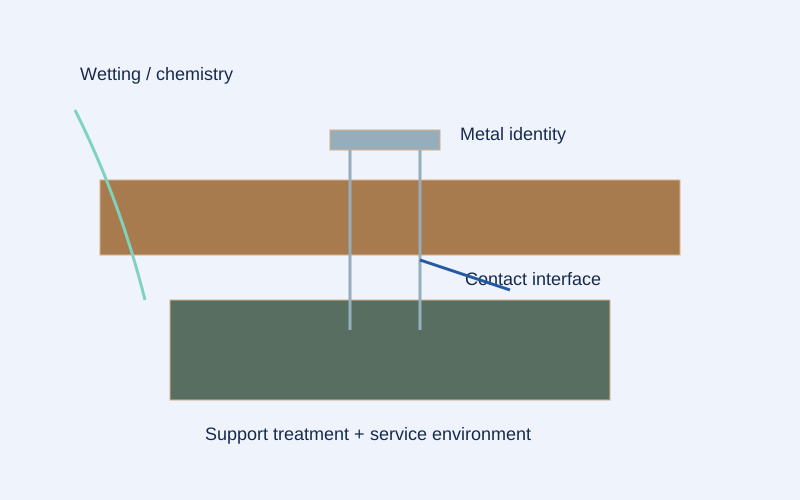
- Identify each metal and the exact support treatment.
- Wetting and chemistry act at the contact interfaces, including sheltered locations.
- The diagram maps questions, not a grade recommendation or corrosion service-life estimate.
Identify the support independently
Record the supporting wood product, treatment information, and labels available on site. Keep the hardwood surface material in a separate field. An attractive untreated face does not describe the substrate through which its fasteners pass. If treatment identity is unknown, mark it unknown and seek purchase or treatment records rather than inferring chemistry from color.
Build a contact map
Sketch the fastener path and show each material it contacts, including clips, washers, connectors, membranes, and flashing. Include the portion embedded in the support. This simple map helps reviewers notice that a proposed screw has more than one compatibility question and that concealed contact may differ from what is visible at the board surface.
Ask the right corrosion question
USDA's guide addresses metal corrosion in copper-treated wood and design strategies for reducing it. The practical question is whether the proposed hardware is accepted for this treatment and exposure, not whether a package uses the general word exterior. Obtain the applicable written compatibility information and identify any conditions that must be met for the intended use.
Keep barriers within their approved detail
If a separation layer is proposed, document its material, continuity, penetrations, and installation requirements. Ask how the fastener and connector are treated in that detail. Do not assume a strip placed between two broad surfaces isolates every metal contact or changes the embedded screw's exposure. Review the proposed assembly rather than crediting an unspecified barrier with complete protection.
Make substitutions visible
Compare the original and alternative fasteners by material, coating, dimensions, head, and intended application. Include the treated-support information in the substitution request. During receiving, photograph treatment tags and hardware labels together with their respective location records. Keeping those records linked is more useful than an invoice that simply lists deck screws and treated framing.
Practical checklist
- Recover treatment identification from records or labels.
- Map all direct and embedded material contacts.
- Obtain product-specific treatment compatibility evidence.
- Document separation layers as part of the assembly.
Worked example
Hypothetical example: a hardwood replacement job retains existing treated joists. The team discovers that the proposed hardware review covered only the hardwood, adds the joist treatment record, and requests a complete compatibility response before purchase.
Limits of this guide
This guide supplies no universal coating thickness, acceptable treatment combination, or corrosion lifetime. Unknown treatment remains an unresolved input. Structural performance and any separation detail require acceptance for the actual connection.
Continue the decision
Map mixed-metal contacts before approving a connection
Submit the connection as one coordinated assembly
Record corrosion evidence without guessing remaining life
Connection worksheet