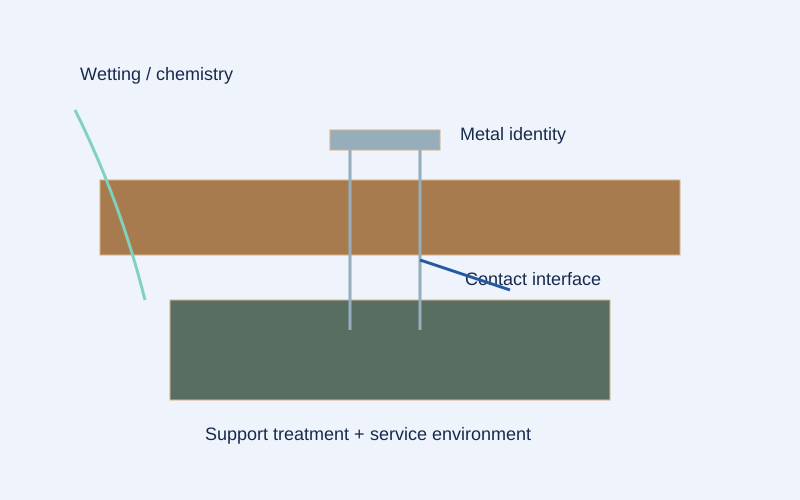
- Identify each metal and the exact support treatment.
- Wetting and chemistry act at the contact interfaces, including sheltered locations.
- The diagram maps questions, not a grade recommendation or corrosion service-life estimate.
Describe the actual application
Identify the connection location, purpose, board profile, support, and exposure. Include a section showing the proposed assembly and a plan reference for repeated locations. State whether the review concerns a new detail, product substitution, or existing-condition repair. This framing helps the reviewer understand which assumptions must be checked instead of reading isolated product sheets without context.
Schedule every component
List exact products for fasteners, clips, connectors, washers, and separation layers. Record documented alloys or coatings and treatment information for wood contacts. Include relevant geometry and product revisions. Mark unknowns conspicuously. A schedule that says stainless hardware or exterior screws leaves too much of the connection undefined for a meaningful compatibility decision.
Attach the applicable evidence
Provide the installation instructions and the technical documentation used to support the proposed application. Identify the pages or sections that address this combination rather than attaching a large document without explanation. USDA's fastening reference supplies background principles; it does not approve a proprietary system. Ask the reviewer to identify any conditions or exclusions that affect the proposal.
Expose deviations and interfaces
Compare the proposal with the project requirement in a short table. Include changed profile geometry, substrate, metal contact, screw shape, or exposure assumption. Address starts, edges, terminations, and concealed locations alongside typical field connections. Give each open item an owner and a requested resolution so an approval mark cannot obscure an unanswered compatibility question.
Plan verification and handover
Define which component labels and installation stages will be photographed before concealment. Link those records to locations and the accepted submittal revision. Include inspection access and product maintenance information for the owner. If the accepted system changes during procurement, revise the coordinated package and obtain the necessary disposition before mixing old and new components on site.
Practical checklist
- State application and review scope clearly.
- Identify the complete component combination.
- Point to evidence applicable to that combination.
- Carry accepted revisions into receiving and handover.
Worked example
Hypothetical example: a clip substitution changes the required screw while the purchase list retains the old screw. A coordinated component schedule catches the mismatch, and the revised submittal resolves the complete pairing before installation.
Limits of this guide
Document completeness does not equal engineering approval. The responsible reviewer establishes capacity, code compliance, and exposure suitability. No generic guide can certify an assembly whose products, installation, or supporting conditions remain unknown.
Continue the decision
Separate hidden clip fit from connection acceptance
Compare screw geometry before accepting a substitute
Map mixed-metal contacts before approving a connection
Connection worksheet