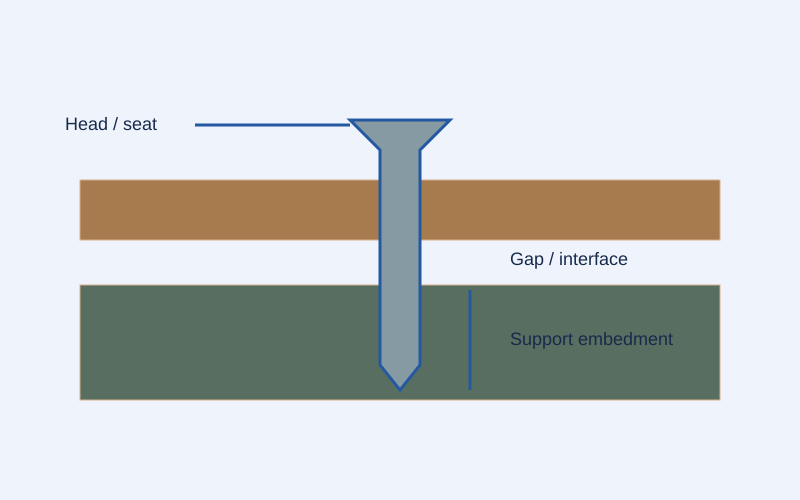
- Overall screw length is not the same as support embedment.
- The head and clip or board interface affect seating.
- Required size, pilot hole and embedment must come from the exact system and design.
Describe the complete screw
Record product identity, nominal size description, overall length convention, thread extent, head style, drive, point, material, and coating. Include a clear side photograph and the relevant drawing. Similar package descriptions can conceal different shapes. Keep measured observations separate from manufacturer-stated dimensions so a reviewer knows which information is verified by product documentation.
Show the path through the assembly
Draw the board, clip or connector, any intervening layer, and the supporting member. Identify where the head seats and where the threaded portion is intended to work. Do not treat overall length as automatically equal to useful engagement. Ask the project or product detail to establish the required geometry for the complete stack of materials.
Compare head and interface
Check that the proposed head is the specified type for the connector or board detail. Record seating observations from a permitted sample installation rather than assuming that a head fitting through an opening will seat correctly. Keep overdriving, visible deformation, and inability to follow the installation instructions as distinct observations that need resolution.
Review installation requirements
Obtain the product's instructions for the intended wood and attachment system, including any prescribed preparation or tooling. USDA recognizes that fastening design depends on wood and joint conditions. Do not supply a universal pilot-hole rule for every hardwood or copy a procedure from a different screw. A substitution review should include whether the approved installation method changes.
Create an equivalence table
Place specified and proposed products in adjacent columns, with a third column for unresolved differences. Attach the application evidence and the reviewer's disposition. At receiving, compare labels to the accepted alternative rather than to a verbal description. Keeping the approved product identifier on the site record reduces later confusion when several screw types are used nearby.
Practical checklist
- Compare head, thread, point, material, and size.
- Show the complete material stack and seating point.
- Check installation instructions for the intended application.
- Document unresolved differences before substitution.
Worked example
Hypothetical example: an alternative has the same overall length but a different thread extent and head. The team requests connection-specific acceptance instead of approving the substitution because both packages describe the same nominal length.
Limits of this guide
This guide does not establish penetration, spacing, edge distances, pilot-hole dimensions, or capacity. Those requirements depend on the specified connection. A visually similar screw is not automatically an engineered equivalent.
Continue the decision
Separate hidden clip fit from connection acceptance
Specify stainless fasteners with evidence beyond the label
Submit the connection as one coordinated assembly
Connection worksheet