Text equivalent
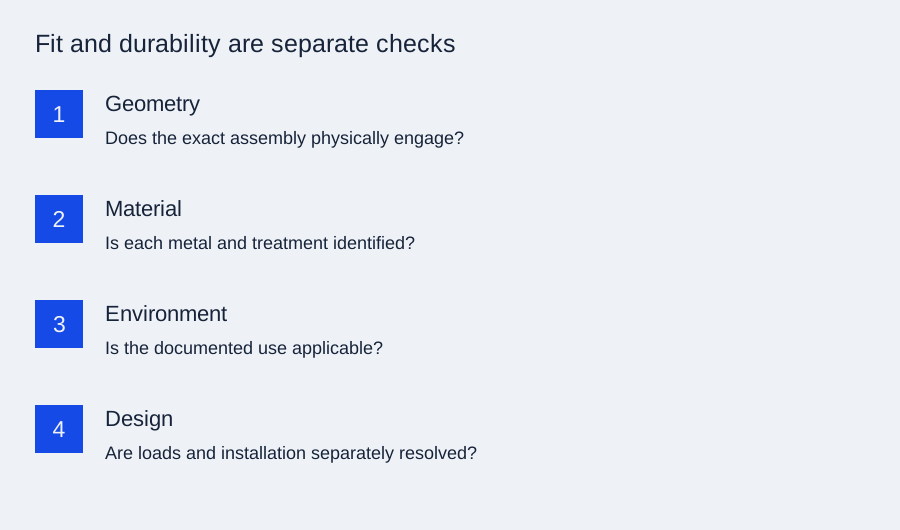
Geometry
Does the exact assembly physically engage?
Material
Is each metal and treatment identified?
Environment
Is the documented use applicable?
Design
Are loads and installation separately resolved?
A clip that fits a groove is not thereby approved for that board, exposure or structural demand.
Download diagram (SVG)Original educational diagram · Fastener Compatibility · September 14, 2026.
Apply this diagram
Use this diagram to separate a successful physical trial from an evidence-backed connection decision. A part seating neatly is useful information, but it answers only the fit question tested by that trial.
State what the trial actually demonstrated
Record the exact pieces used and the conditions of the trial. Was it an unfastened sample showing engagement, or an installation using the specified screw and support? Which dimensions were measured, and which were only observed? Keep those distinctions with any photographs.
A bench sample does not silently resolve the supplied production tolerance, the permitted drying condition or the manufacturer’s installation requirements. Compare the actual profile evidence with the exact system requirements before describing a mechanical match as verified.
Review exposure as a separate question
The same-looking assembly may be proposed for different wetting, salt or treatment conditions. Record the project exposure and ask whether the product evidence covers that use. A geometry drawing cannot answer that question, and a general material label should not be used to close it.
Likewise, an exposure statement does not establish the groove dimensions or fastening path. Keep fit, material identity and documented use as separate checks. A clear result should explain which checks are resolved and which remain conditional or missing.
Do not turn a sample into a fastening schedule
Support arrangement, attachment frequency, edge conditions and project loads require their own applicable basis. A successful fit trial does not provide those values. Avoid adding guessed dimensions to a rendering simply to make the assembly look complete.
Use a sample photograph alongside the profile and installation records. Label it as a trial of named parts, including the date and any limitations. If a part changes, the old trial remains evidence of the old combination.
Worked review example
Fictional review: a clip engages a sample groove, but the proposed screw is a different product from the one identified in the system instructions. Record the observed engagement without approving the substituted screw. Resolve the accessory question through applicable documentation before carrying the sample result into the connection record.
Record before handing off
- Trial parts identified
- Observed fit separated from dimensional verification
- Material and exposure evidence reviewed independently
- Substitutions identified
- Project attachment design kept separate from the fit trial
These are original review workflows, not product specifications or compatibility approvals. Use the connection worksheet to retain the questions, and consult the source and evidence guidance for the limits of the references.