Text equivalent
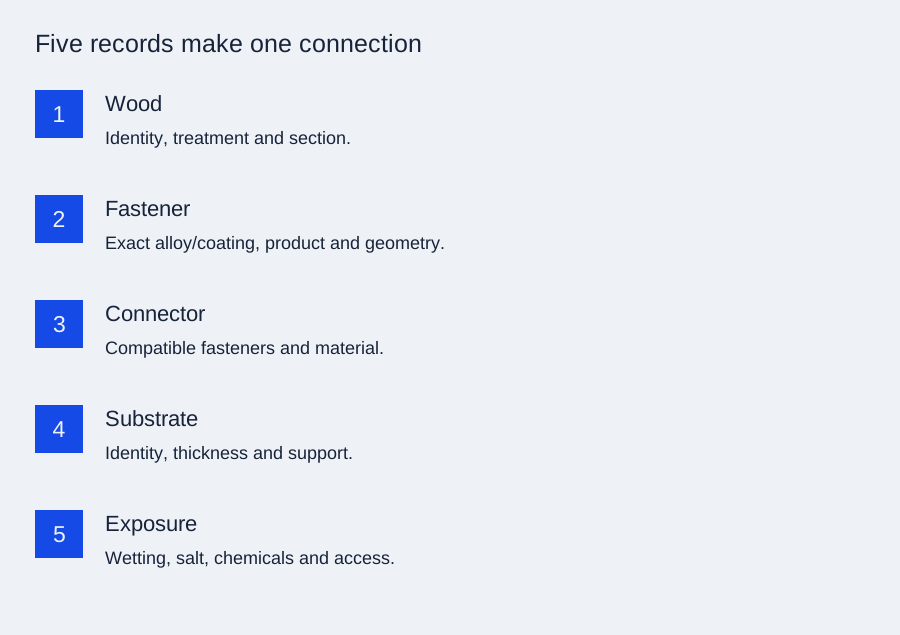
Wood
Identity, treatment and section.
Fastener
Exact alloy/coating, product and geometry.
Connector
Compatible fasteners and material.
Substrate
Identity, thickness and support.
Exposure
Wetting, salt, chemicals and access.
One missing record can leave a connection question unanswered. A completed record is not a technical approval.
Download diagram (SVG)Original educational diagram · Fastener Compatibility · September 14, 2026.
Apply this diagram
Use this diagram when a submittal identifies the visible hardware but leaves the rest of the connection unnamed. Read across all five records before deciding what has actually been established.
Identify the supplied parts, not just the product families
Start with the board actually being supplied: species, drying condition, treatment where relevant, and the profile drawing or measured section record. “Ipe decking” leaves the groove, thickness and delivery condition unresolved. Keep a manufacturer’s required profile separate from evidence that the supplied board meets it.
For the fastener and connector, record exact product identifiers and the instruction revision being used. A photograph can help identify a candidate; it cannot confirm alloy, coating, screw length or an approved substitution. If the clip instruction calls for an accessory screw, retain that screw’s identifier with the clip rather than treating it as a separate purchasing choice.
Attach each document to the question it answers
A profile drawing answers a geometry question. A species-and-drying chart answers a different applicability question. An exposure statement may restrict where the combination can be used. Name the relevant page, table or instruction beside the corresponding record so another reviewer can follow the same chain.
Do not count the number of uploaded documents as evidence completeness. Five documents describing the clip do not supply a missing board drawing. Record the unresolved question in plain language: “Supplied groove position not confirmed” is more useful than “More information needed.”
Keep revisions connected
When a board, screw, treatment or substrate changes, revisit the records that relied on it. Keep the earlier decision with its original identifiers and mark the replacement proposal separately. This prevents a confirmation for one combination from appearing to approve a later substitution.
The worksheet is a record of the review. Completing every field does not itself establish compatibility; the applicable evidence and any required project review still determine the result.
Worked review example
Fictional review: the clip model and installation instruction are known, but the mill has supplied only a nominal board size. The clip is identified; the board-to-clip match remains pending. Request the supplied profile drawing and compare it with the selected system’s documented requirements. Do not fill the missing groove dimensions from a visually similar board.
Record before handing off
- Exact board and profile reference recorded
- Fastener, connector and accessory identifiers retained
- Substrate and exposure described
- Each claim tied to its applicable source and revision
- Missing or conflicting evidence left visible
These are original review workflows, not product specifications or compatibility approvals. Use the connection worksheet to retain the questions, and consult the source and evidence guidance for the limits of the references.