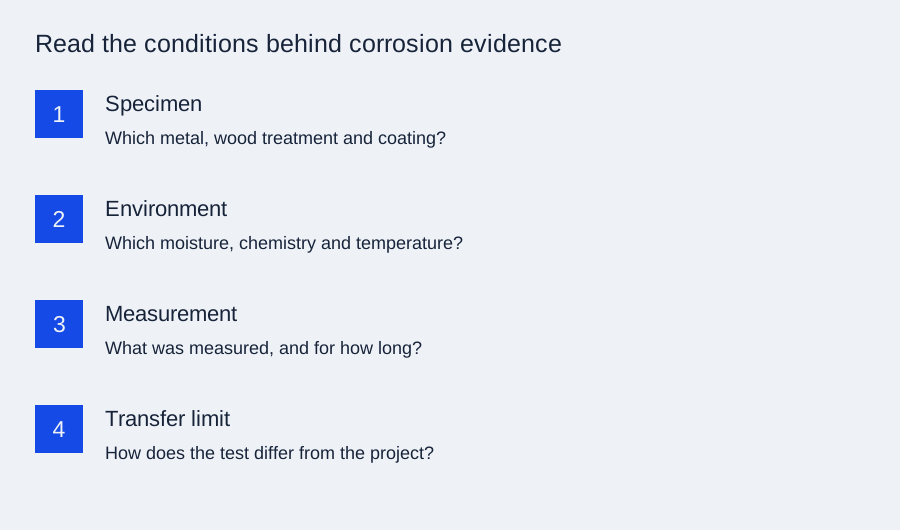
Text equivalent
Specimen
Which metal, wood treatment and coating?
Environment
Which moisture, chemistry and temperature?
Measurement
What was measured, and for how long?
Transfer limit
How does the test differ from the project?
A laboratory result supports its test conditions. It is not automatically a service-life prediction for a different connection.
Download diagram (SVG)Original educational diagram · Fastener Compatibility · September 14, 2026.
Apply this diagram
Use this diagram when a corrosion claim is supported by a test report, chart or photograph. The first task is to understand the evidence’s scope before applying it to a different connection.
Read the specimen description first
Identify what was tested: the metal or coating, the fastener or coupon, and any contacting material included in the test. If the report names a treatment or preparation method, retain that information. Do not replace a specific description with a broad label such as “outdoor hardware.”
Keep the supplied product identifier beside the tested specimen. If they differ, make that difference explicit and request the evidence connecting the report to the proposed product. Similar appearance is not that connection.
Retain the method, duration and measured outcome
Copy the report’s stated exposure conditions and measured endpoint accurately. A photograph of discoloration, a mass-change measurement and a mechanical test result are different kinds of observations. Do not summarize them all as “passed corrosion testing” unless that is the documented result and its criteria are clear.
Record the test duration in its original units. Do not convert laboratory hours into years of outdoor service without a documented basis applicable to the product and use. If the report does not make that prediction, the project record should not introduce it.
Compare the report with the proposed connection
List the project’s relevant contact materials and exposure conditions beside those described in the evidence. Mark each item as matching, different or unknown; avoid hiding differences in a general statement that both uses are exterior.
This comparison helps formulate a precise question for the supplier or responsible reviewer. It does not create an approval rule. Retain any response with its product identifiers, stated conditions and revision so the next reviewer can see what was actually confirmed.
Worked review example
Fictional review: a supplier presents a report for a coated specimen, while the project record names an unidentified coating on a screw in treated wood. The immediate questions are whether the supplied coating is the tested product and whether the evidence addresses the proposed contact condition. The report may be relevant, but neither question is answered merely by attaching it.
Record before handing off
- Specimen and supplied product distinguished
- Test method and duration retained
- Measured outcome described accurately
- Project differences and unknowns listed
- No unsupported service-life conversion added
These are original review workflows, not product specifications or compatibility approvals. Use the connection worksheet to retain the questions, and consult the source and evidence guidance for the limits of the references.